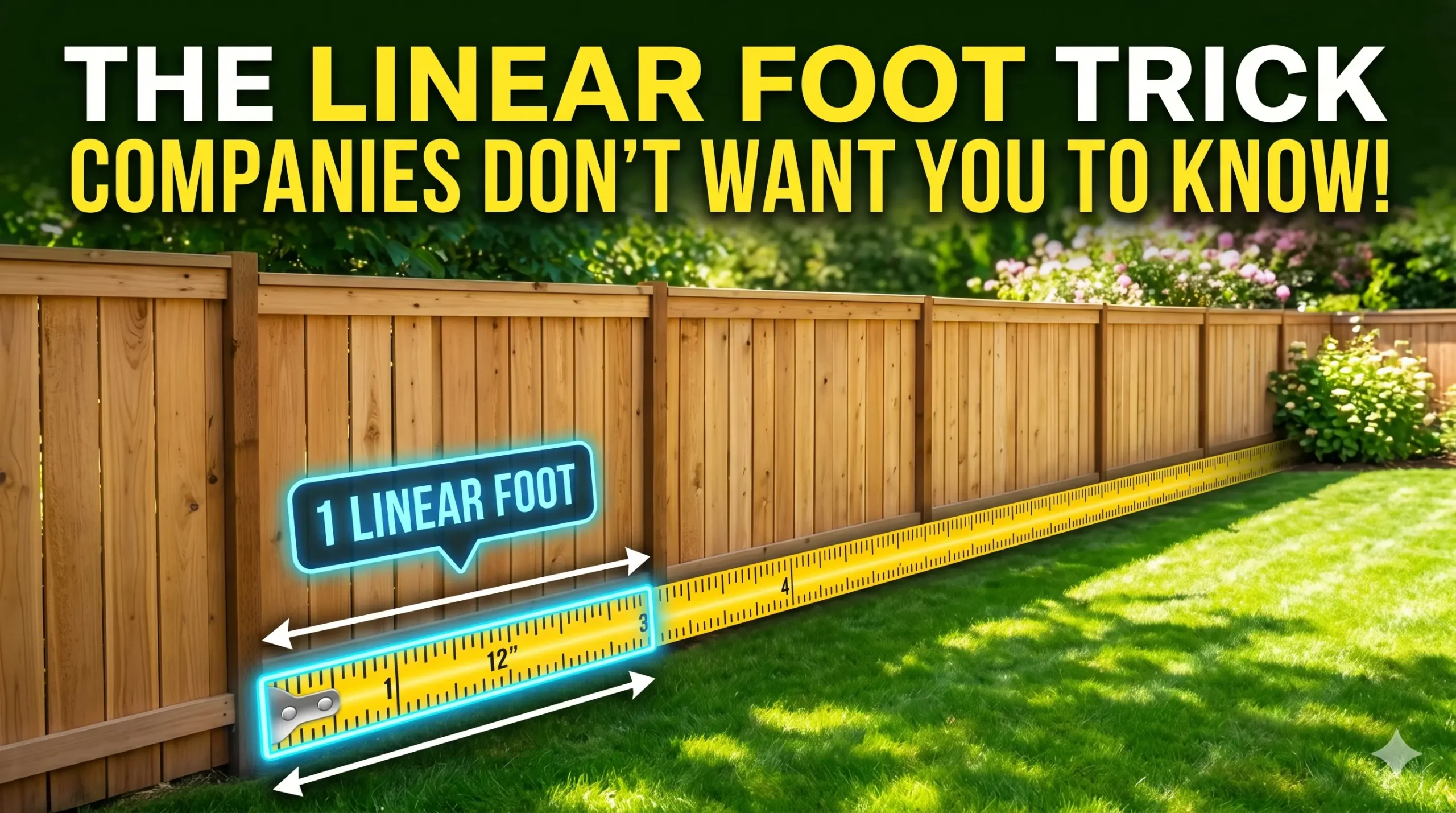
A linear foot in fencing equals 12 inches of straight-line fence length, measured from end to end without considering height or width. This measurement determines how much fencing material you need and directly impacts your total project cost.
Understanding linear feet is crucial for accurate fence estimates, avoiding costly material mistakes, and getting fair quotes from contractors. Whether you’re installing wood, vinyl, chain link, or aluminum fencing, this guide will walk you through everything you need to know.
What Exactly Is a Linear Foot?
A linear foot is simply a measurement of length in a straight line. One linear foot equals exactly 12 inches, just like a regular foot. The word “linear” emphasizes that we’re measuring only length—not width, height, or area.
Key Points About Linear Feet:
- 1 linear foot = 12 inches
- Measures only length in a straight line
- Does not factor in fence height
- Also called “running foot” (the terms are interchangeable)
- Used for materials sold by length: wood, vinyl, chain link, aluminum
For example: If you have a fence that’s 6 feet high and 100 feet long, your fence is 100 linear feet long. The 6-foot height doesn’t change the linear footage.
Linear Feet vs. Square Feet: What’s the Difference?
Many homeowners confuse linear feet with square feet. Here’s the critical distinction:
| Feature | Linear Feet | Square Feet |
|---|---|---|
| What it measures | Length only | Length × Width (area) |
| Dimensions | 1-dimensional | 2-dimensional |
| Used for | Fencing, trim, pipes, fabric | Flooring, walls, countertops |
| Calculation | Measured directly | Length × Width |
| Fencing application | Total fence length | Fence panel area (rarely used) |
Why this matters for fencing: Fences are sold by linear foot because contractors care about how long your fence line is, not the surface area. A 6-foot tall privacy fence and a 3-foot tall picket fence covering the same perimeter both require the same linear feet of material.
Why Fencing Is Measured in Linear Feet
Fencing is measured in linear feet for several practical reasons:
1. Material Ordering Simplicity
Fence posts, rails, panels, and mesh are manufactured and sold in length-based units. Chain link mesh comes in rolls measured by linear foot. Wood pickets and vinyl panels are priced per foot of length.
2. Cost Calculation Clarity
The basic cost formula is straightforward:
This makes budgeting predictable for homeowners and contractors alike.
3. Standard Industry Practice
Wood fences, chain link fences, aluminum fences, vinyl fences, and chain link privacy slats are all often sold by the linear foot. This standardization makes comparisons easier.
4. Focus on Perimeter, Not Area
For fencing, the total distance around your property (perimeter) is what matters most. The height is a separate specification that affects material thickness and post strength, but not the linear footage calculation.
How to Measure Linear Feet for Your Fence (Step-by-Step)
Accurate measurement is critical for getting the right amount of materials and avoiding expensive mistakes. Follow this professional approach:
Tools You’ll Need:
- Measuring wheel (fastest for long distances)
- Long tape measure (most precise for short runs)
- Stakes or flags to mark corners
- Notepad or phone notes app
Step 1: Start at a Fixed Point
Begin at a permanent landmark like a house corner, existing fence corner, or property pin. Place a stake here to mark your starting point.
Step 2: Walk the Fence Path
Walk along your planned fence line, marking each corner or change in direction with a stake or flag. This creates a visual outline of your fence path.
Step 3: Measure Each Straight Section
Measure corner-to-corner for each straight run. Write down each measurement immediately—don’t trust your memory.
Step 4: Add All Sections Together
Sum all your straight-line measurements to get total linear feet.
Example: For a rectangular yard that’s 50 feet by 75 feet:
Step 5: Account for Gates
Measure the width of each gate and add it to your total. A 4-foot gate adds 4 linear feet to your measurement.
Step 6: Add 10% for Waste
Always add about 10% to your total for waste, cuts, and adjustments. Better to have extra than come up short.
Linear Feet to Inches Conversion Table
Use this quick reference table when converting measurements:
| Linear Feet | Inches | Common Use Case |
|---|---|---|
| 1 LF | 12″ | Single picket or panel section |
| 5 LF | 60″ | Small garden fence section |
| 10 LF | 120″ | Gate opening + adjacent panels |
| 25 LF | 300″ | Side yard fence run |
| 50 LF | 600″ | Half a typical residential side |
| 100 LF | 1,200″ | Full backyard perimeter (small lot) |
| 200 LF | 2,400″ | Average suburban property |
| 500 LF | 6,000″ | Large rural property section |
To convert inches to linear feet: Divide total inches by 12
Fence Cost Per Linear Foot (2026 Prices)
Understanding costs per linear foot helps you budget accurately. Here are current average prices:
| Fence Type | Material Cost per LF | Installed Cost per LF | Lifespan |
|---|---|---|---|
| Chain Link | $5 – $15 | $8 – $25 | 15–25 years |
| Wood Picket | $8 – $20 | $10 – $36 | 15–20 years |
| Wood Privacy (6′) | $8 – $20 | $15 – $45 | 15–20 years |
| Vinyl Picket (4′) | $12 – $30 | $15 – $35 | 25–30 years |
| Vinyl Privacy | $12 – $30 | $30 – $55 | 25–30 years |
| Aluminum | $12 – $30 | $20 – $55 | Lifetime |
| Wrought Iron | $45 – $65 | $45 – $65 | Lifetime |
| Composite | $20 – $45 | $30 – $75 | 25–30 years |
Labor costs typically run $5–$15 per linear foot, included in most contractor quotes.
Example calculation: A 200 linear foot wood privacy fence at $25/LF installed = $5,000 total.
Common Mistakes When Measuring Linear Feet
Avoid these frequent errors that lead to costly mistakes:
1. Ignoring Slope
A fence running up a hill needs more material than one on flat ground. Sloped terrain increases the actual linear distance.
2. Forgetting Gates and Corners
Each corner post and gate adds linear footage. Gate widths must be included in your total measurement.
3. Not Measuring Each Section Separately
Measuring the entire perimeter in one go leads to errors. Measure corner-to-corner for accuracy.
4. Skipping the 10% Buffer
Without extra material for cuts and waste, you may run short. Always add 10%.
5. Relying on Property Deeds Alone
Property deeds show legal boundaries, not actual fence placement. Measure on-site for the most accurate quote.
6. Not Double-Checking Measurements
Walk the line twice before ordering. It’s cheaper to re-measure than to order more materials later.
Why Accurate Linear Foot Measurement Matters
Cost Accuracy
Underestimating linear feet means additional orders, delivery fees, and potential material color mismatches. Overestimating wastes money on unused materials.
Material Efficiency
Proper measurement ensures you order exactly what you need. Fence panels come in standard sizes (often 6-foot or 8-foot sections), so accurate measurements prevent waste.
Contractor Quote Comparisons
When every contractor measures the same linear footage, you can apples-to-apples compare quotes based on price per foot rather than total cost variations.
Permit Compliance
Many municipalities require accurate fence measurements for permits. Incorrect linear footage can delay approval or cause inspection failures.
Special Considerations for Different Fence Types
Wood Fences
- Posts typically spaced 8 feet apart
- Solid privacy fences need ~2.3 pickets per linear foot
- Shadowbox style needs ~3.0 pickets per linear foot
Chain Link Fences
- Mesh sold by linear foot at your chosen height
- Posts typically spaced 10 feet apart
- Most cost-effective option at $5–$15/LF material
Vinyl Fences
- Posts typically spaced 6 feet apart
- Panels come in pre-assembled 6-foot or 8-foot sections
- Premium pricing but minimal maintenance
Aluminum Fences
- Similar spacing to vinyl (6 feet)
- Upscale appearance with lifetime durability
- Higher initial cost but no maintenance
Quick Calculator: Estimate Your Fence Materials
Use these formulas to estimate materials once you know your linear footage:
Posts Needed:
- Wood: 8-foot spacing
- Chain link: 10-foot spacing
- Vinyl/Aluminum: 6-foot spacing
Pickets Needed (Wood Privacy):
Mesh Needed (Chain Link):
FAQs About Linear Feet in Fencing
1. Is a linear foot the same as a regular foot?
Yes. One linear foot equals exactly 12 inches, the same as a regular foot. The word “linear” just emphasizes you’re measuring length in a straight line, not area or volume.
2. Does fence height affect linear foot measurement?
No. A 3-foot tall picket fence and a 6-foot tall privacy fence covering the same perimeter both require the same linear feet. Height affects material cost per foot but not the linear measurement itself.
3. How do I measure linear feet for a curved fence?
Measure each straight segment separately, following the curve in small sections. Add all segments together. For gentle curves, a measuring wheel works best.
4. Should I include gate openings in my linear footage?
Yes, include the width of all gates in your total linear footage. A 4-foot gate adds 4 linear feet to your measurement because you need framing materials for that space.
5. What’s the difference between linear feet and running feet?
There is no difference. “Linear foot” and “running foot” are interchangeable terms that both refer to a 12-inch straight-line measurement.
6. How much extra should I order beyond my linear footage?
Add 10% to your total linear footage for waste, cuts, and mistakes. If you need 200 linear feet, order 220 linear feet worth of materials.
7. Can I use Google Maps to measure linear feet?
Yes, Google Maps’ “Measure distance” tool works well for budgeting and early estimates. Right-click your starting point, select “Measure distance,” and click along your fence path. However, for final quotes, use an on-site measuring wheel for best accuracy.
8. Why do contractors charge per linear foot instead of per panel?
Linear foot pricing is more flexible and accurate. Panel sizes vary by manufacturer, but linear feet is a universal standard. It also accounts for custom cuts, gates, and irregular fence lines.
Final Thoughts: Master Linear Feet for Fence Success
Understanding linear feet is the foundation of any successful fencing project. By measuring accurately, accounting for gates and corners, and adding appropriate waste buffers, you’ll avoid costly mistakes and get fair, comparable quotes from contractors.
Remember these key takeaways:
- 1 linear foot = 12 inches of straight-line length
- Fence height doesn’t change linear footage
- Measure each section corner-to-corner
- Include all gates in your total
- Add 10% for waste
- Double-check your measurements
Whether you’re installing a simple chain link fence or an elegant vinyl privacy fence, accurate linear foot measurement ensures you order the right materials, budget correctly, and complete your project without surprises.
Take your time measuring, use the right tools (measuring wheel + tape measure), and don’t hesitate to walk your fence line twice. A few extra minutes of measurement now saves hundreds of dollars in mistakes later.